Dubai Signals Green Light For Ripple — Is XRP Set to Power The Future of Global Remittances?
- Mathew Jacob

- 2 days ago
- 2 min read
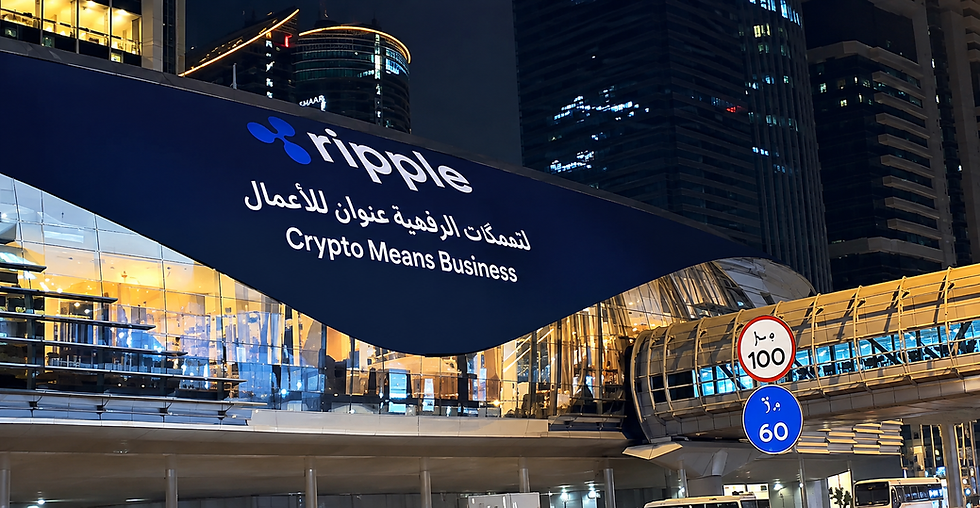
Dubai is rapidly positioning itself as a global fintech hub, and recent developments around Ripple have sparked fresh excitement across the crypto industry. Reports and announcements tied to the UAE suggest increasing regulatory openness toward blockchain-powered payment solutions, fueling speculation that Ripple’s infrastructure — and potentially XRP — could play a bigger role in cross-border remittances. While headlines claiming “Dubai approves Ripple for global remittances” may sound definitive, the reality is more nuanced but still significant.
The United Arab Emirates has been steadily building one of the most progressive regulatory environments for digital assets. Through entities like the Dubai Financial Services Authority and VARA, Dubai has created frameworks that allow licensed firms to operate crypto payment services legally. Ripple has already established a regional presence in Dubai, which serves as its Middle East and North Africa headquarters — a strategic move that reflects the region’s growing importance.
Ripple’s core offering, often referred to as Ripple Payments (formerly ODL), enables near-instant cross-border transactions using blockchain technology. In corridors where it is active, XRP can be used as a bridge currency to eliminate the need for pre-funded accounts. This is particularly relevant in remittance-heavy regions like the UAE, where billions of dollars flow annually to countries such as India, Pakistan, and the Philippines.
However, it’s important to separate regulatory support from direct approval of XRP usage. As of now, there is no official confirmation that Dubai has mandated or fully adopted XRP for national remittance infrastructure. Instead, what exists is a supportive ecosystem where companies like Ripple can operate, test, and expand their services under regulatory supervision. This distinction is often lost in viral social media posts.
That said, the opportunity is real. The UAE’s focus on becoming a cashless, digitally advanced economy aligns closely with Ripple’s mission to modernize global payments. Partnerships with regional financial institutions and fintech firms could gradually increase XRP’s utility, especially in high-volume remittance corridors where speed and cost efficiency are critical.
From a market perspective, narratives like this tend to drive optimism around XRP. Traders and investors often interpret regulatory openness as a precursor to mass adoption. But adoption in financial systems typically happens in phases — pilot programs, limited rollouts, and then scaled implementation — rather than overnight transformations.
In conclusion, while Dubai has not officially “approved XRP for global remittances” in the absolute sense, it has created one of the most favorable environments for Ripple to expand its payment solutions. The door is open — but whether XRP walks through it at scale will depend on regulatory clarity, institutional adoption, and real-world use cases in the months and years ahead.